Human Direction for AI in Deal Teams: Execution vs Autonomy
Human Direction for AI in Deal Teams: Execution vs Autonomy
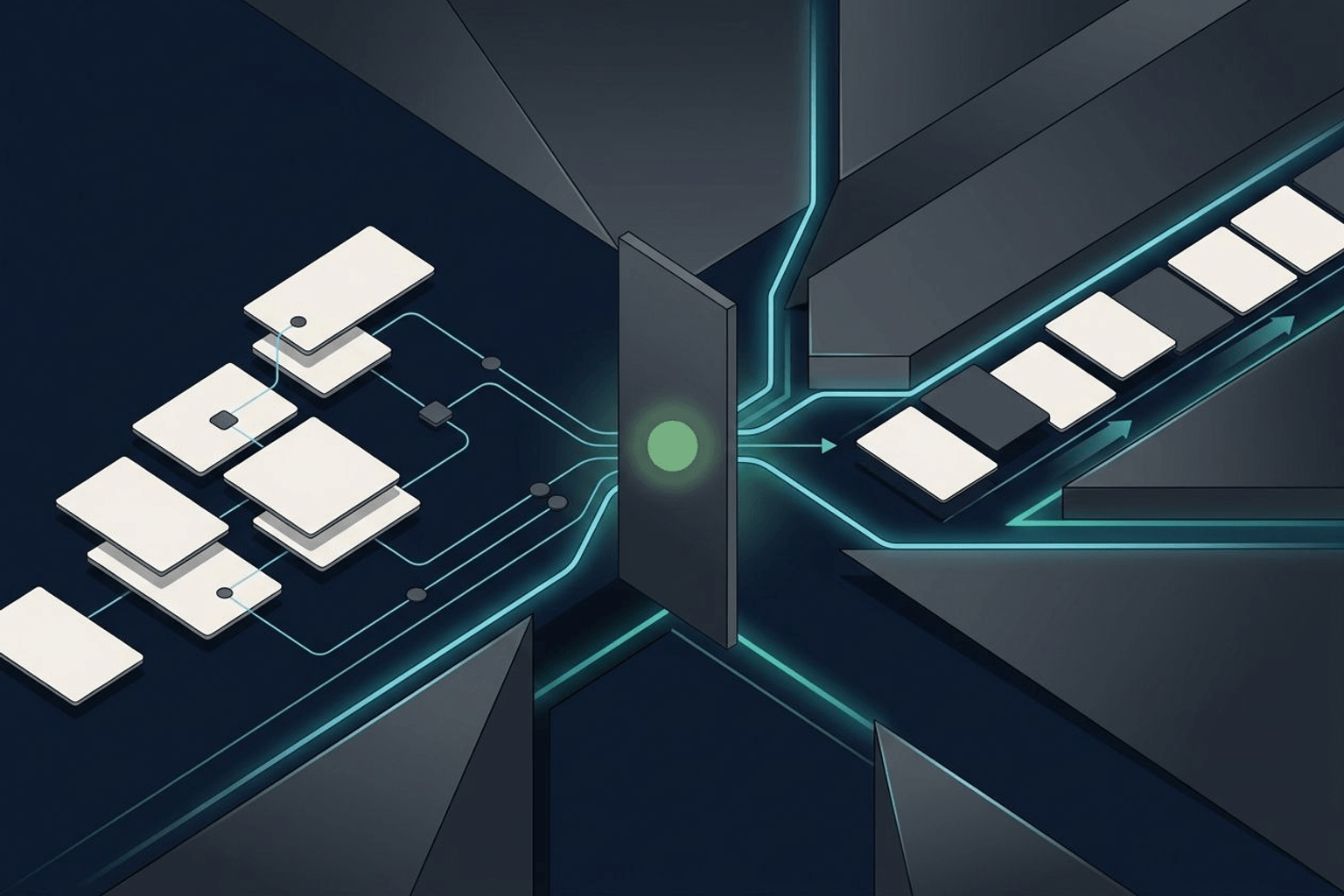
Deal teams are being offered assistants, agents, workflows, and autonomous systems as if the terms mean the same thing. They do not. The difference matters because each mode carries a different level of authority, operating risk, and review obligation.
A useful platform should tell you which mode is active, what it can do, what limits apply, and where a human decision is required. If the boundary is hard to explain, it is probably too loose.
AI in M&A: From Chat Assistance to Governed Agent Workflows
In an interactive exchange, a user asks for research, analysis, or a draft and stays present to guide the work. The system may call tools, but the user controls the objective and reviews the result before using it. This is the narrowest authority boundary and often the right place to start.
An orchestrating agent may hand parts of a task to specialists or run bounded workstreams in parallel. From the outside, that can look autonomous. It is still a supervised run launched for one defined objective. Delegation makes the work broader; it does not make the authority persistent.
A governed workflow adds a reusable definition with inputs, phases, permissions, limits, retry policy, and terminal states. Each launched run remains tied to the approved workflow version so later edits do not silently change work already in progress.
In Resiliq, users can inspect run state, request cancellation, and retry eligible failures within policy. In a diligence workflow, parallel workstreams settle before the system records completed and missing evidence and moves to synthesis. A missing domain does not disappear just because the rest of the output is ready.
Autonomy begins when work can start or continue without a user present.That mode may begin after a schedule or governed data event and needs stricter controls: an approved definition, bounded authority, duplicate handling, budgets, health visibility, cancellation, retry limits, and an accountable operator.
Availability is workflow- and tier-dependent. Agent tools, memory, and multi-agent coordination do not automatically mean an unattended recurring job is available or appropriate.
Structuring AI Authority and Delegation in Private Equity Diligence
A corporate-development manager launches a supervised diligence workflow for a target. Several bounded workstreams run in parallel. One fails after its allowed attempts, and the synthesis reports the missing domain. The manager reviews the partial result, decides the gap is material, corrects the input, and authorises a retry.
Later, the team considers a job that refreshes an approved market screen when governed data changes. That is a separate product decision, not a switch the first workflow can simply turn on. It needs permitted event types, bounded downstream work, an owner, and a review path for the output.
For every workflow, the authority map should answer practical questions: Who can launch it? Which data can it access? Which tools may it use? Can it reach external services? How much work and cost can it consume? What can trigger it? How are retries and cancellation handled? Where does the output go, and who must approve it?
This is also a useful buying test. A vendor that can show the authority boundary clearly is easier to evaluate than one that asks you to trust a vague promise of autonomy.
A Concrete Example: The Diligence Escalation Breakpoint
To see how human oversight functions in live execution, consider a mid-market buyout scenario. While parsing an unstructured virtual data room, a diligence agent identifies a discrepancy: the management presentation lists three key founder shareholders with standard 4-year vesting, but an unindexed amendment in a subsidiary agreement reveals an accelerated single-trigger change-of-control payout and conflicting drag-along thresholds.
In an ungoverned AI system, the model might average the numbers or generate a summary that glosses over the conflict. In Resiliq, the conflict triggers an immediate Escalation Breakpoint: the agent pauses the deal valuation workflow, highlights the exact clause discrepancy with side-by-side citations, and requires the deal lead to select the legal interpretation before the quantitative cap table engine calculates net proceeds.
AI Governance and Model Risk Controls for Investment Teams
First, define the objective and stop condition. Second, identify the data, tools, and external services the workflow can reach. Third, cap time, cost, retries, and downstream work. Fourth, name the person who reviews failures, partial results, and policy changes. If any answer is vague, the workflow is not ready for unattended execution.
The OECD AI Principles organise trustworthy AI around human rights and fairness, transparency and explainability, robustness and safety, and accountability. They were adopted in 2019 and updated in 2024.[1]Those principles are easier to apply when authority is explicit rather than hidden behind a label such as assistant or agent.
A workflow should stop when its access is revoked, its budget is exhausted, required evidence is absent, or the operating context changes materially. Completed work can remain available for review, but the system should not smooth a failed domain into a complete answer.
The UK Government's 2025 AQuA Book treats assurance as a lifecycle responsibility and distinguishes the commissioner, analyst, independent assurer, and approver.[2]A deal team may use different titles, but the separation is useful: the person requesting work, the system or analyst producing it, and the person approving its use should not collapse into one invisible role.
Begin with interactive assistance. Move to reusable workflows once outputs are reviewable and failure modes are understood. Add unattended execution only when triggers, limits, ownership, and review paths are explicit. This staged progression preserves control and conviction as execution scope grows.
See the human-directed workflow boundary in Resiliq and decide where supervised execution is enough and where a governed job needs stronger controls.
Human-in-the-Loop Oversight and Auditability in Automated Deal Workflows
A team should not move directly from a successful chat demonstration to unattended execution. Increase authority in stages. First confirm that users can inspect sources and correct outputs. Then test specialist delegation, cancellation, partial results, and bounded retries. Only after those controls work should the team consider scheduled or event driven runs.
Each stage needs an exit test. Can access be revoked? Does the run stop when its limit is reached? Are unsupported actions refused? Can a reviewer distinguish completed evidence from missing work? A broader authority grant should depend on observed control performance, not confidence in the model's prose.
McKinsey's 2025 global survey found that 23 percent of respondents said their organisations were scaling an AI agent somewhere, while 39 percent were experimenting with agents. In any single business function, no more than 10 percent reported scaling agent use. The survey covers organisations generally, not private market deal teams, but it supports treating autonomy as an adoption stage rather than a settled default.[3]
Direct one Resiliq workflow from objective to review and see where human judgment remains explicit, visible, and decisive.
References
- OECD, AI Principles, updated 2024
- UK Government Analysis Function, The AQuA Book, 2025
- McKinsey & Company, The state of AI in 2025: Agents, innovation, and transformation, 5 November 2025
Explore Solutions
Private Equity
Private equity software for deal sourcing, company research, due diligence, LBO and M&A modelling, and portfolio decision support.
M&A Professionals
AI-powered M&A software for target research, source-grounded due diligence, transaction modelling, and deal-team decision support.
Investment Banking
AI-powered investment banking software for company research, deal diligence, M&A modelling, valuation scenarios, and client materials.
Corporate Development
AI-powered corporate development software for target discovery, market research, M&A scenario analysis, and strategic decision support.
Related Articles
Owning the AI Operating Model: Security, Control, and Choice
An enterprise AI operating framework for finance: enforce strict tenant isolation, sandboxed execution, consequence-bounded agents, and vendor independence.
20 May 2026
The IC Evidence Standard for Investing with AI
Establish an institutional Investment Committee evidence standard. Carry sources, disclosed assumptions, and audit trails into AI-assisted deal underwriting.
18 June 2026
Resiliq Launches AI Agents: Governed Execution for Private Markets
Resiliq announces the launch of Resiliq Agents, bringing governed AI execution, parallel diligence, and reviewable deal workflows to private capital teams.
12 November 2025