From Data Room Evidence to the Financial Deal Model
From Data Room Evidence to the Financial Deal Model
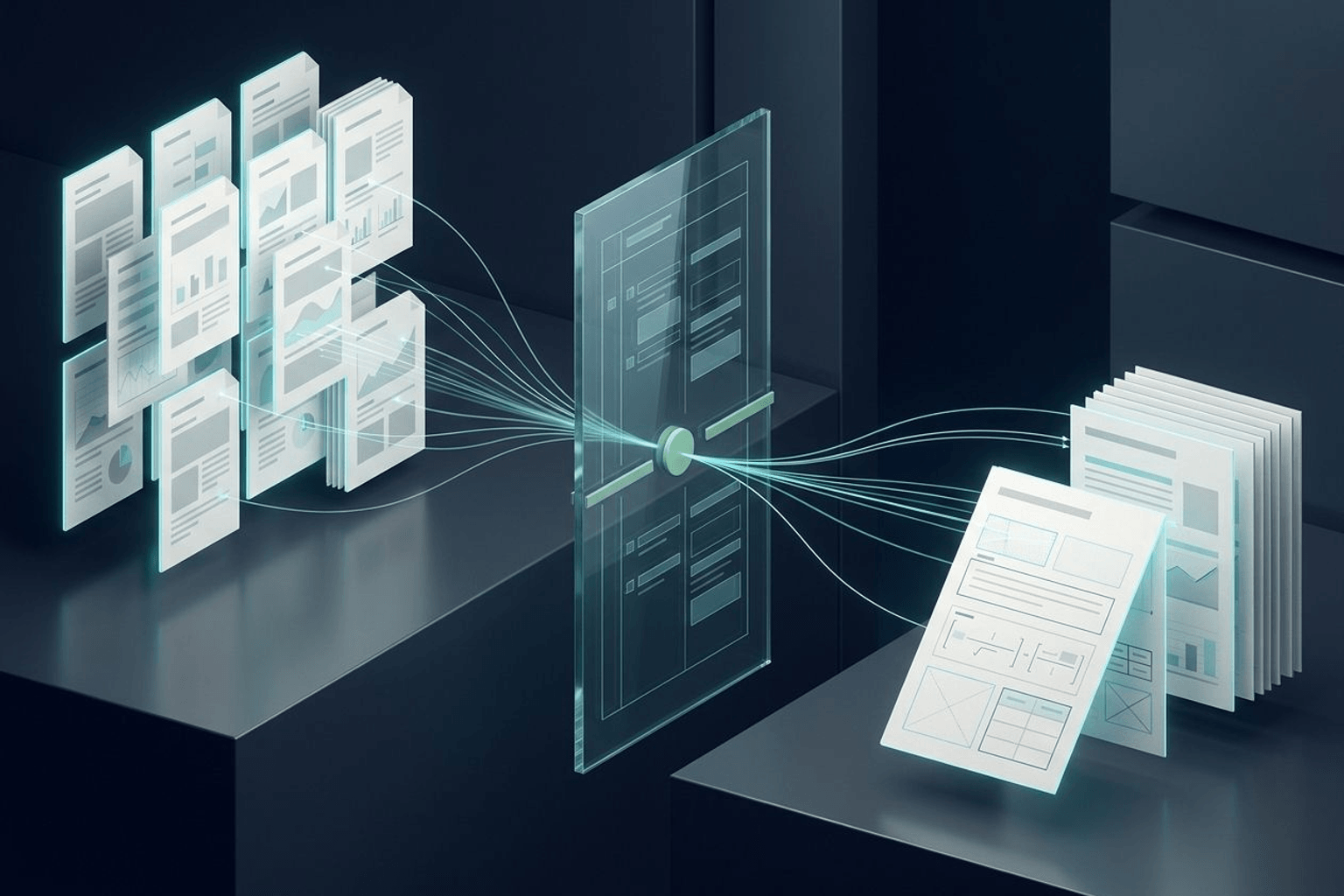
Diligence and modelling often run beside each other rather than together. One team reviews documents and writes findings. Another builds assumptions and scenarios. The investment committee receives a memo and workbook. Somewhere between those handoffs, the evidence behind a model input can disappear.
That gap is not abstract. It shows up when a partner asks why churn moved, where an EBITDA adjustment came from, or whether a covenant case reflects the latest contract. The analyst knows there was a reason. The workflow should make the reason easy to inspect.
Virtual Data Room Due Diligence: Running Parallel Workstreams
A data room may contain audited statements, management schedules, contracts, presentations, duplicated files, and old versions that look current at first glance. External research adds another evidence class. Before analysis begins, the workflow should record source identity, version, observation context, permissions, and known coverage gaps.
AI can help classify documents and extract material. Extraction is not verification.A value from a management schedule may conflict with a contract or reported statement. The discrepancy belongs in the review record, where an analyst can resolve it, not in a generated summary that chooses a side silently.
Financial, commercial, technical, and contractual reviews can run at the same time when their scope and authority are clear. Each workstream should settle before synthesis records what completed and what remains missing.
In scoped Resiliq diligence workflows, bounded execution and retries keep missing workstreams visible through synthesis, giving reviewers a structured basis for challenge.
Linking Data Room Findings Directly to Financial Model Assumptions
A material finding should never change a deal model by stealth. If customer concentration supports a downside retention case, the link from evidence to assumption should be recorded. If a quality-of-earnings adjustment changes EBITDA, the calculation, owner, source, and review state should stay attached to it.
The quantitative engine should own the calculation. Its output should expose the input snapshot, methodology, assumptions, warnings, and completion state. An agent may explain the result, but fluent prose should not substitute for consistent financial logic.
Consider an illustrative acquisition where contract review finds that a material customer's renewal option is shorter than the revenue plan assumes. The finding links to the source clause and waits for analyst review. The analyst approves a downside renewal assumption and reruns the model. The revised output records the changed assumption and its effect on leverage, returns, and covenant headroom.
The IC package presents base and downside cases, the evidence link, the warning that no customer interview was available, and the review status. Committee members can challenge the assumption and reproduce the scenario without searching a separate diligence archive or asking which workbook contains the latest case.
Illustrative Diligence-to-Model Adjustment Bridge
In an institutional underwriting workflow, qualitative findings from data room documents translate directly into explicit numerical bridge adjustments:
- Reported Management EBITDA: €14.5M base forecast presented in vendor marketing materials.
- Diligence Finding 1 (Software R&D Recategorization): -€1.2M adjustment. Contract review identifies capitalised maintenance expenses that must be expensed under target accounting policy (Source: VDR-FIN-042, Note 4).
- Diligence Finding 2 (Top Customer Renewal Buffer): -€0.8M downside margin buffer. Customer contract review reveals volume rebate clauses taking effect in Year 2 (Source: VDR-COM-019).
- Underwritten Adjusted EBITDA: €12.5M underwritten baseline.
- Model & Return Impact: Opening leverage adjusts from 4.2x to 4.9x Debt/EBITDA; projected 5-year IRR shifts from 24.5% to 19.8%; senior debt covenant headroom tightens by 140 bps—all tracked with full auditability in the final IC memo pack.
Audit Trails and Evidence Hierarchy for Investment Committee Approval
An evidence-to-model handoff should list the finding, source and date, affected model input, transformation or adjustment, scenario membership, owner, approval status, warnings, and downstream outputs. A rejected finding should remain visible as a decision rather than vanish from the record.
Materiality remains a transaction-specific professional judgment. Legal interpretation, accounting judgement, expert escalation, management credibility, and final model approval remain human responsibilities. The workflow also depends on authorised source access and suitable model coverage.
Not every document deserves the same weight. Audited accounts, executed contracts, management schedules, adviser work, interview notes, and external research answer different questions and carry different limitations. The SEC notes that private placements may provide less disclosure than registered offerings and that offering documents may not have been reviewed by a regulator or present risks in a balanced way.[1]
A finding should record its evidence class and review state. A signed contract may establish a legal term. A management schedule may support an operating assumption. An interview may identify a question that still needs corroboration. Combining them into one paragraph without these distinctions creates false equivalence.
The UK Government's 2025 AQuA Book distinguishes verification, whether analysis meets its specification, from validation, whether it is fit for its intended purpose. It also recommends assurance throughout the analytical lifecycle and in proportion to the consequence and complexity of the work.[2]
That distinction is useful for deal models. A formula can calculate correctly while the assumption is unsuitable. The reviewer needs both checks: does the model implement the approved logic, and does the approved logic answer the transaction question with the available evidence?
Valuation judgement also needs a stated basis. The IPEV Valuation Guidelines describe current best practice for reporting private capital investments at fair value.[3]A deal workflow should preserve which valuation approach, comparable set, or transaction evidence informed an assumption rather than presenting the output as a uniquely correct number.
The goal is not a bigger diligence archive.It is a cleaner path from a source fact to the assumption it changed and the decision it informed. That path makes review faster to navigate and easier to challenge and defend.
Managing Dynamic Diligence Updates and Valuation Sensitivities
The real test of evidence lineage is not whether the first memo can be produced. It is whether the team can respond when a document changes. Replace a management schedule, revise an adjustment, or receive a new contract. The workflow should identify the affected finding, assumption, scenario, and conclusion without asking the analyst to reconstruct every handoff.
This change test also exposes stale work. A model may still calculate correctly while relying on an assumption that no longer reflects the approved evidence. The review record should distinguish a refreshed calculation from a genuinely refreshed investment case.
Lost lineage creates work at the worst time: before an IC meeting, during lender review, or after a material diligence update. Measure how often analysts search for the source of a number, reconcile competing workbook versions, or rewrite narrative after a model change. The value of a connected workflow lies in reducing that repeated reconstruction while making unresolved evidence more visible.
Take one data-room question into Resiliq and follow the reviewed evidence into an explicit model assumption and an IC-ready decision record.
Important notice
This article provides general information only. It is not investment, valuation, financial, legal, tax, accounting, financing, or other professional advice, recommendation, solicitation, or offer concerning any company, security, transaction, strategy, or product. Examples are illustrative and not forecasts. Resiliq references describe capabilities reviewed at the time of writing, not promises of future availability, performance, or outcomes.
References
- SEC Office of Investor Education and Advocacy, Private Placements under Regulation D, updated 2022
- UK Government Analysis Function, The AQuA Book, 2025
- International Private Equity and Venture Capital Valuation Board, IPEV Valuation Guidelines 2025
Explore Solutions
Private Equity
Private equity software for deal sourcing, company research, due diligence, LBO and M&A modelling, and portfolio decision support.
M&A Professionals
AI-powered M&A software for target research, source-grounded due diligence, transaction modelling, and deal-team decision support.
Investment Banking
AI-powered investment banking software for company research, deal diligence, M&A modelling, valuation scenarios, and client materials.
Corporate Development
AI-powered corporate development software for target discovery, market research, M&A scenario analysis, and strategic decision support.
Related Articles
The IC Evidence Standard for Investing with AI
Establish an institutional Investment Committee evidence standard. Carry sources, disclosed assumptions, and audit trails into AI-assisted deal underwriting.
18 June 2026
Private Equity Due Diligence: From Data Room to Deal Model
Learn how private equity teams run parallel due diligence across virtual data rooms, bridge findings into financial deal models, and verify evidence before IC.
20 November 2025
The Lean Deal Team's Evidence Loop: Sourcing to IC Review
How lean private equity teams gain operating leverage by connecting target screening, data room diligence, and valuation models directly into the IC memo.
4 August 2026