AI in Private Equity: From Search to Governed Workflows
AI in Private Equity: From Search to Governed Workflows
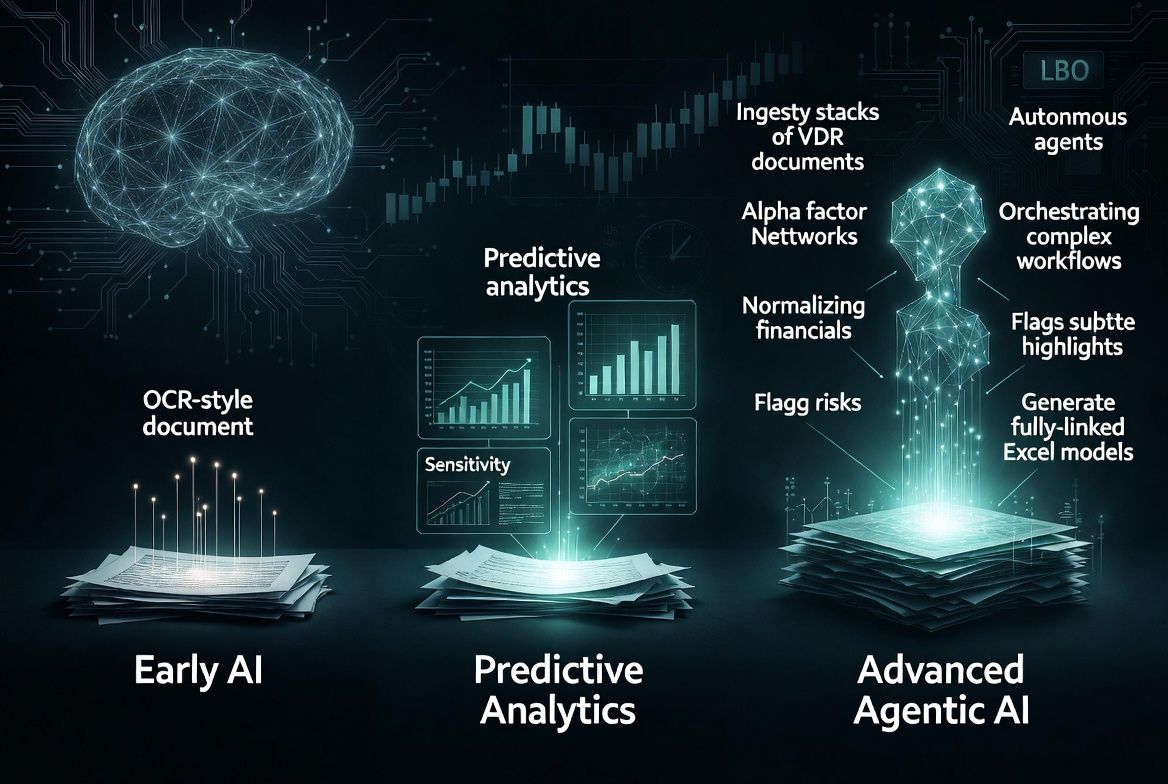
Not long ago, “AI in private equity” often meant OCR or keyword search: finding a clause in a virtual data room instead of reading every page by hand. Useful, but limited. The harder work — connecting evidence, testing assumptions, building the model, and preparing the IC case — still sat with analysts and associates.
McKinsey's 2024 Global Private Markets Report described generative AI adoption in private markets as nascent, with pilot programmes in flight but few general partners having scaled implementations. [1] The important distinction is not between manual work and full autonomy. It is between isolated tools and governed workflows that preserve evidence and human authority as the work moves from research to decision.
Phase 1: Semantic Search and Document Extraction in Virtual Data Rooms
The first wave reduced document friction. Teams could search contracts, extract tables from PDFs, and normalise company records. These tools improved access to information, but the analyst still had to connect every fact to the investment thesis, model, and decision record.
Phase 2: Source-Grounded Market Research and Quantitative Deal Analysis
The next phase made the context around a fact more important. A useful answer identifies the entity, source, observation date, and coverage limit. Alongside that evidence, quantitative models can test valuation, leverage, credit, and scenario assumptions using deterministic calculations rather than generated arithmetic.
This is augmented analysis, not a prediction machine. Sparse private-company data should produce explicit assumptions and wider uncertainty ranges. A model becomes more useful when reviewers can see its inputs and warnings, not when its output looks more precise.
Phase 3: Governed AI Agent Workflows for Private Capital DealOps
The current frontier is coordinated execution. Specialist agents can work across target research, commercial diligence, financial analysis, and other bounded domains. The deal lead still sets the thesis, reviews the evidence, challenges the assumptions, and makes the investment call.
Resiliq workflows expose run state, bounded retries, and missing evidence. Published definitions can be revision-pinned so a later edit does not silently change an active run. Persistent or event-driven jobs sit behind a stronger authority boundary and are not the same thing as specialist delegation inside a supervised task.
Interactive Prompts vs. Governed Team Jobs in Private Equity
The true institutional leap in private equity is the transition from single-turn chat prompts to governed, background-executed Team Jobs:
- Interactive Prompts (Single-Turn): Ad-hoc analyst queries for fast executive summaries, initial company overview cards, or searching specific terms in an uploaded filing.
- Governed Team Jobs (Multi-Step Workflows): Scheduled, multi-agent background executions such as automated overnight registry ingestion across 500 watchlisted targets, automated quarterly debt covenant health monitoring, or real-time data room change diffing on new seller uploads.
How Modern Private Equity Funds Deploy AI in Deal Execution
For a lean team, the benefit is not an autonomous agent that looks impressive in a demonstration. It is continuity. Research arrives with source context. Diligence findings remain connected to the questions they answer. Model assumptions stay visible. Reviewers can see what completed, what changed, and what remains uncertain.
That operating model lets teams cover more ground without lowering the standard of review. It also makes adoption more practical: begin with one bounded workflow, test whether the output improves the real decision process, and expand authority only when the team understands the failure modes.
Building an Enduring Competitive Edge in Private Market Dealmaking
The meaningful divide will not be between firms that “use AI” and those that do not. It will be between teams that accumulate disconnected tools and teams that build a repeatable, governed way to move evidence into decisions. The latter is harder to demonstrate in a single prompt. It is also much harder to copy.
See how Resiliq connects research, diligence, modelling, and review in one governed process for private-equity deal teams.
References
Explore Solutions
Private Equity
Private equity software for deal sourcing, company research, due diligence, LBO and M&A modelling, and portfolio decision support.
M&A Professionals
AI-powered M&A software for target research, source-grounded due diligence, transaction modelling, and deal-team decision support.
Investment Banking
AI-powered investment banking software for company research, deal diligence, M&A modelling, valuation scenarios, and client materials.
Venture Capital
Venture capital software for thesis-led company research, market mapping, founder and market diligence, valuation scenarios, and portfolio context.
Related Articles
Resiliq Launches AI Agents: Governed Execution for Private Markets
Resiliq announces the launch of Resiliq Agents, bringing governed AI execution, parallel diligence, and reviewable deal workflows to private capital teams.
12 November 2025
The Lean Deal Team's Evidence Loop: Sourcing to IC Review
How lean private equity teams gain operating leverage by connecting target screening, data room diligence, and valuation models directly into the IC memo.
4 August 2026
From Data Room Evidence to the Financial Deal Model
Connect virtual data room diligence directly to your financial deal model. Preserve source audit trails, test assumptions, and eliminate manual model re-entry.
29 June 2026